The free DISC assessment that gives you real insights, not just a label.

Your Free report includes four DISC scores, strengths and a seven-day observation worksheet.
No purchase required.

Start your free DISC assessment

Question 1 of 50

I hold my work to a high standard and will review it multiple times before submitting.

Strongly DisagreeStrongly Agree

Choose an answer to continue.

50 questions · Free report · No purchase required

After question 50, we ask for your name, email, phone and purpose.

Assessments delivered
250,000+
Questions in the full assessment
50
Typical time to complete
15–20 min
Your free assessment result
$0

Used by professionals from organizations including

  • Google
  • Microsoft
  • Deloitte
  • American Express

From questions to your report

  1. Answer 50 questionsRate statements, rank options, choose between alternatives and select all that apply.
  2. Add your detailsYour name, email, phone and the reason you’re taking it.
  3. Read your Free reportOnline and by email. Premium is optional.
What happens after I begin?
  1. Answer here. All 50 questions run in this card. Your answers are saved as you go on this device, so you can come back and continue where you left off.
  2. Work through 50 questions. Rate statements, rank options, choose between alternatives and select all that apply. You can go back and change an answer before finishing.
  3. Add your report details. After the questions, we ask for your first and last name, email, phone number and reason for taking the assessment.
  4. Read your Free report. You see your result online and receive the report by email. Use it to understand your tendencies and choose one practical insight to discuss. No purchase is required.
  5. Keep Free. Add Premium if you want more guidance. You keep access to your Free report and add the Premium report for … USD once, before applicable taxes. Both use the same answers; you do not retake the assessment.
  6. Put the insight to work. Use the Quick Start for a conversation. Organizing a group? Create a free Workspace. Coaches and trainers can explore the Partner offer.
Before you begin

What is a DISC
assessment?

The idea of four basic temperaments goes back to the ancient Greeks. In 1928, Harvard-trained psychologist William Moulton Marston formalised it into the DISC model, a framework for how people direct and express their energy in response to their environment. It describes how you tend to work, not how capable you are.

  • Dominance

    How directly you push towards a result.

    Decisive, direct, competitive, results-first

  • Influence

    How much you work through people and energy.

    Enthusiastic, persuasive, sociable, optimistic

  • Steadiness

    How much you value patience, stability and support.

    Calm, loyal, patient, dependable

  • Conscientiousness

    How much you rely on accuracy, quality and logic.

    Precise, analytical, careful, systematic

Fast or steady Dominance and Influence lean towards pace and action. Steadiness and Conscientiousness lean towards care and consistency.

Task or people Dominance and Conscientiousness focus on the work. Influence and Steadiness focus on the people doing it.

01 / See what you’ll receive

Explore Free and Premium
DISC sample reports.

Explore a sample by style

You don’t need to know your style. Pick any style to compare Free and Premium for the same example person.

Make a fast change easier to follow.

Free · understand how you work

The Forced Pivot
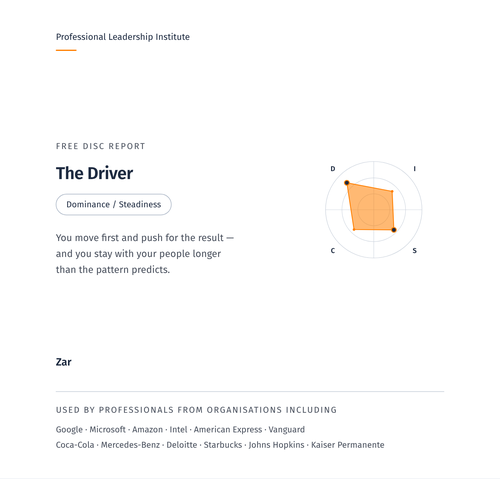
D Free example report coverOpen Free sample
Possible cost
“The people who just aligned to the old plan feel whiplashed, not informed”

Free names a recurring pattern and a possible cost to check against your experience.

Also inside this Free example

  • See how decisiveness and loyalty combine. Explore the four scores, profile chart and D/S blend in this example.
  • Recognize everyday habits. Read about decisive action, results focus and direct communication.
  • Name strengths worth keeping. Explore making expectations clear, helping a room decide, speaking plainly and backing colleagues.
  • Check how your message lands. Compare possible intentions behind speed, honesty and loyalty with how others might read them.
  • Notice the pattern at work. Examine the Forced Pivot, then use observation cues, a seven-day worksheet and a colleague check to explore what fits.
Read this excerpt in context in the D Free sample See the D Free worksheet
Premium adds · choose a response

Give the reason before the new direction.

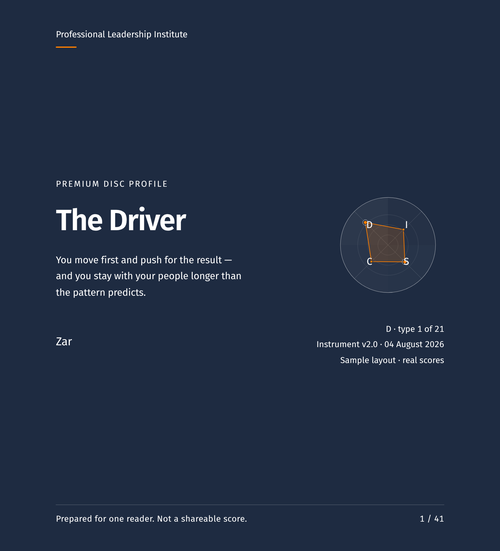
D Premium example report coverOpen Premium sample
A move to try
“Say what changed and why in one sentence before you announce the new direction”

Everything in Free, with more ways to put it to work

  • Explain a changed direction. Explore the Forced Pivot, the Withheld Correction and other recurring patterns, each linked to a suggested alternative.
  • Adjust directness without losing the point. Compare useful and overused settings for making the call, being direct, backing people, moving fast and taking control.
  • Prepare the difficult sentence. Find example language for explaining a change, giving a hard consequence, offering loyal teammates feedback and inviting a challenge to your decision.
  • Notice what pressure changes. Consider pushing harder, taking tasks back and hiding exhaustion alongside suggestions for naming the load and renegotiating it.
  • Test an earlier feedback habit. Use three experiments to notice delayed corrections, try earlier feedback and ask a close colleague what they experience.
Explore more in this D Premium sample
  • Check how speed and loyalty may land. Compare six possible gaps between intent and impact, then choose examples to discuss with someone who knows your work.
  • Understand why a disagreement can feel unfinished. Follow the same disagreement through the moment, the same day and two days later, including a colleague who needs more time to respond.
  • Pressure-test a fast decision. See the gathering, loyalty-check and commitment stages, with a question to consider before a decision involving someone you back.
  • Identify conditions that help you deliver. Explore clear ownership, visible goals, room to act and honest challenge, alongside working conditions worth discussing with your manager.
  • Prepare for greater responsibility. Consider what changes when your decisions affect a team, including buy-in, fairness and hard calls involving loyal colleagues.
  • Adapt a conversation to the other person. Use four D/I/S/C conversation cards with an opening, something to avoid and a question to ask; check the person’s preferences rather than assuming their style.
  • Keep a one-page working guide. Return to a concise reference covering what to watch, what to say more often, when to slow down and what support to ask for.
See the changed-plan pattern and alternative in the D Premium sample

Keep the enthusiasm. Check the commitment.

Free · understand how you work

The Yes That Outran the Calendar

I Free example report coverOpen Free sample
Possible cost
“Your unusually solid structure now has to scramble to fit one more thing in”

Free helps you notice when a quick yes becomes an extra commitment.

Also inside this Free example

  • See how energy and follow-through interact. Explore the example’s four scores, profile chart and combination of enthusiasm, ideas and structure.
  • Recognize everyday habits. Read about idea generation, magnetic energy and structured follow-through.
  • Name strengths worth keeping. Explore building relationships, drawing people into a conversation and making others feel heard.
  • Separate enthusiasm from a commitment. Compare an excited yes with the promise another person may hear.
  • Notice when the calendar gets crowded. Examine the Yes That Outran the Calendar, then use observation cues, a seven-day worksheet and a colleague check.
Read this excerpt in context in the I Free sample See the I Free worksheet
Premium adds · choose a response

Check capacity before saying yes.

I Premium example report coverOpen Premium sample
Words to try
“I got excited and want to say yes — let me check what I can actually do first.”

Everything in Free, with more ways to put it to work

  • Connect enthusiasm with capacity. Explore patterns such as the yes that outruns the calendar, selling a vision before the structure exists and scattering across too many ideas.
  • Find a useful setting for your energy. Compare balanced and overused settings for saying yes, generating ideas, holding a standard, making commitments and structuring follow-through.
  • Put a pause into words. Use example language for checking capacity before saying yes and other situations where excitement, commitment and follow-through can diverge.
  • Recognize overload before another commitment. Explore over-promising, scattered attention and wanting to escape, with suggestions for choosing one priority and pausing before a new yes.
  • Check promises against follow-through. Try three experiments: count commitments, name a concrete next step before agreeing, and ask whether promises matched what happened.
Explore more in this I Premium sample
  • Check what an enthusiastic yes communicates. Compare six possible intent-and-impact gaps, including an idea heard as a promise and a lively conversation that leaves little room for others.
  • Separate a better mood from a resolved issue. Follow a disagreement across the moment, the same day and two days later, including a colleague who still wants the facts examined.
  • Check a decision before the excitement commits you. Explore the path from excitement to commitment to structure, with a capacity question to ask before saying yes.
  • Find conditions that support ideas and delivery. Explore variety, recognition, social contact and time to build an idea, alongside conditions that can make follow-through harder.
  • Build beyond your own energy. Consider the shift from doing the work yourself to leading a team whose follow-through needs systems that work without you in the room.
  • Turn connection into a useful next conversation. Use four D/I/S/C conversation cards to practise leading with an outcome, slowing down, checking another view or bringing evidence.
  • Keep a one-page follow-through reference. Revisit the sample’s watch-outs, capacity checks, ways to credit the team and requests for help prioritising.
See the six conversation scripts in the I Premium sample

Keep the helpfulness. Notice the limit.

Free · understand how you work

When accommodating is misread

S Free example report coverOpen Free sample
Possible intent
“Accommodating, to keep things pleasant”

Free pairs this possible intent with “A limit that’s being quietly overstepped.” Check the interpretation with someone who knows your work.

Also inside this Free example

  • See steadiness alongside assertiveness. Explore the four scores, profile chart and S/D blend in this example.
  • Recognize everyday habits. Read about steadfast loyalty, noticing relationship dynamics and speaking up.
  • Name strengths worth keeping. Explore helping people feel valued, sensing what they need and becoming someone they can speak openly with.
  • Check what accommodation communicates. Compare keeping things pleasant with a limit others may not realize they are crossing.
  • Notice the disagreement left unsaid. Explore its possible cost, then use observation cues, a seven-day worksheet and a colleague check.
Read this excerpt in context in the S Free sample See the S Free worksheet
Premium adds · spot an overused strength

Know when support becomes overuse.

S Premium example report coverOpen Premium sample
Overuse setting
“You’re absorbing more than is fair, and no one notices because you never said”

Everything in Free, with more ways to put it to work

  • Separate helpfulness from overuse. Compare three settings for accommodating, avoiding conflict, sensing needs, speaking up, staying loyal and staying steady.
  • Understand the pattern behind an unspoken limit. Explore disagreement left unsaid, a quiet grudge, prolonged resistance to change and other complete trigger-to-alternative chains.
  • Find words for an honest view. See example sentences for stating what you think and naming when a request has grown beyond what you can keep absorbing.
  • Notice strain before the calm breaks. Explore absorbing too much, a fading assertive voice and freezing under pressure, with suggestions for naming strain and asking for support.
  • Practise a small, clear disagreement. Use three experiments to notice what goes unsaid, say one thing plainly and ask whether others read your quiet as agreement.
Explore more in this S Premium sample
  • Check what your quiet may communicate. Compare six possible gaps between intent and impact, including needing time to adjust being read as resistance and a private hurt being missed.
  • Understand the disagreement the other person missed. Follow what happens when one person carries an issue quietly while a more direct colleague assumes nothing was wrong.
  • Find what would help you decide about change. Explore how human impact, trust and stating a position shape a decision, with a question about what feels unsettled and how much time would help.
  • Name the conditions that help you contribute. Explore a trusted team, steady progress, notice before change and backing when you take a stand, so you can discuss what would help.
  • Prepare to lead change as well as support it. Consider what changes from individual contribution to management and wider responsibility, including when the team needs you to move a change forward.
  • Make your view easier for different people to hear. Use four D/I/S/C conversation cards with an opening, an assumption to avoid and a question that helps you say what is actually on your mind.
  • Keep a one-page guide to your boundaries and support. Return to prompts for saying what you think, naming an imbalance, asking for notice and helping colleagues check whether silence means agreement.
See the three settings of a strength in the S Premium sample

Keep the standard. Change how feedback lands.

Free · understand how you work

Flaw First

C Free example report coverOpen Free sample
Possible cost
“People stop showing you drafts, and you start seeing problems later, closer to the deadline”

Free identifies a possible cost of leading with the flaw, so you can notice whether it fits.

Also inside this Free example

  • See how standards and directness combine. Explore the four scores, profile chart and C/D blend in this example.
  • Recognize everyday habits. Read about structural accuracy, spoken standards and independent judgment.
  • Name strengths worth keeping. Explore catching errors, designing dependable processes and bringing structure to complicated work.
  • Check whether care sounds like criticism. Compare the intention behind a correction with what another person might hear.
  • Notice the cost of leading with the flaw. Examine Flaw First, then use observation cues, a seven-day worksheet and a colleague check.
Read this excerpt in context in the C Free sample See the C Free worksheet
Premium adds · choose a response

Make high standards easier to hear.

C Premium example report coverOpen Premium sample
A move to try
“Name one thing that’s right before the thing that’s wrong. Say both in the same breath”

Everything in Free, with more ways to put it to work

  • Keep standards useful to other people. Explore Flaw First, certainty that runs ahead of evidence, taking work back and other recurring patterns with suggested alternatives.
  • Adjust precision when it becomes costly. Compare three settings for naming standards, spotting flaws, speaking confidently, taking work back, holding criticism and withholding praise.
  • Prepare feedback someone can use. Find example language for naming what is strong before the change you want, alongside five other situation-specific scripts.
  • Recognize when checking turns into control. Explore harder flaw-scanning and tighter processes under pressure, with suggestions to finish one verification, name what is solid and agree what good enough means.
  • Try acknowledgement before correction. Use three experiments to count flaw-first moments, make one acknowledgement and ask the person you correct most what they experience.
Explore more in this C Premium sample
  • Check how a quality standard may be heard. Compare six possible gaps between intent and impact, including care that feels like mistrust and a working conclusion that sounds final.
  • Make sense of the correction that stays with you. Follow a disagreement across the moment, the same day and two days later, including the difference between appearing calm and still re-checking privately.
  • Decide when more checking changes the answer. Explore verification, stating a conclusion and commitment, then consider when speed or human context needs more weight.
  • Ask for conditions that support good work. Explore explicit standards, time to verify and evidence-based discussion, alongside the cost of shifting expectations and speed-only demands.
  • Keep the standard when you cannot check everything. Consider the shift from doing your own verification to describing a standard clearly and trusting other people to apply it.
  • Match the explanation to the conversation. Use four D/I/S/C conversation cards to practise leading with the conclusion, checking how feedback landed or finding where two evidence-based views differ.
  • Keep a one-page guide for working with you. Revisit prompts for acknowledging good work, naming uncertainty, requesting an agreed standard and helping colleagues bring useful evidence.
See the feedback pattern and alternative in the C Premium sample

Examples, not your result. Your report reflects your own answers. These are draft report examples; read the sample notes.

Start your free assessment
02 / Decide how much support you need

Compare Free and Premium
DISC reports.

Free gives you four DISC scores, strengths, communication insights and a seven-day observation worksheet. Premium adds more work situations, conversation scripts and small changes to try over twelve weeks, using the same assessment answers.

Free

Your personal DISC report. Free.

No purchase required · 17-page sample

Understand your working style, recognize strengths and explore how your intentions may land with others. Leave with something you can use in your next conversation.

  • Your four scores and profile chart: see each DISC dimension and explore how your pattern combines.
  • Three everyday traits and four strengths: connect your profile with recognizable work situations.
  • Communication insights: compare possible intentions with how others might interpret them.
  • A growth pattern to watch: examine one recurring habit and its possible cost.
  • A first practice exercise: use three observation cues, a seven-day worksheet and a colleague check to explore what fits.
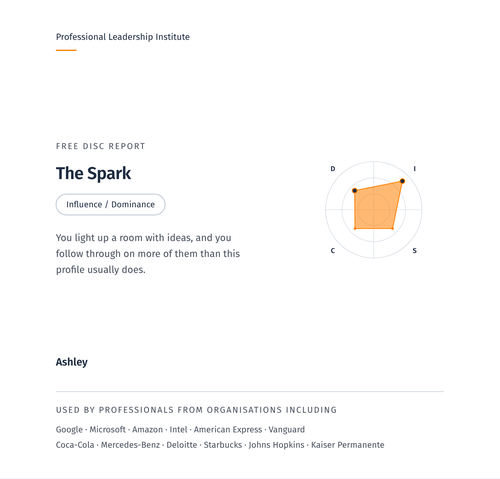
Your Free report is useful on its own. Read it, discuss it and try a first change. Premium is there when you want to go further.

Premium

Everything included in Free, plus…

… USD once · 37-page Premium sample

Keep your complete Free report and add more ways to act on what you learn: prepare a difficult conversation, explore a recurring habit and build a practical development plan.

  • A fuller profile: 14 traits and expanded strengths across four groups.
  • Spot overused strengths: Six capabilities at balanced, productive-edge and overuse settings.
  • Try a different response: Eight patterns map trigger, response, cost and a suggested alternative.
  • Prepare your words: Six intent/effect examples and six scripts to adapt.
  • Explore work situations: Conflict, decisions, stress, work conditions and growing responsibility.
  • Work with others: Four D/I/S/C conversation cards and a one-page guide to working with you.
  • Put insight into practice: Three small experiments across twelve weeks.

The same assessment answers. No retake. Premium adds guidance for you to consider and try.

See the full Premium toolkitPatterns, scripts, work situations and your 12-week plan

Your upgrade keeps the complete Free report available and adds a separate Premium report. Here is what you can explore in the Premium examples.

  1. Your profile, with more detail to reflect on

    Revisit the four scores and how their combination is described. Explore seven everyday traits and seven that may surface under pressure, expanded strengths across four groups, and two examples of strengths that can become costly when overused.

  2. Six strengths at three different settings

    Compare balanced use, a productive edge and overuse for six capabilities. Use the examples to consider where a helpful tendency may be asking too much of you or the people around you.

  3. Eight recurring patterns, explained from trigger to alternative

    Each pattern connects a situation that can set it off, a default response, its possible cost and a suggested alternative. The examples cover ordinary working weeks as well as situations under heavier pressure.

  4. Communication and conflict you can discuss

    Explore six ways intent may differ from impact, guidance on sending and receiving information, and six sentences to adapt to real conversations. Conflict sections compare escalation with recovery, show the same disagreement through four working styles, and distinguish constructive from destructive disagreement.

  5. Decisions, pressure and the conditions around your work

    Follow a decision-making pattern from gathering information to committing. Compare pressure responses with suggested ways to recover, examine energizing and draining conditions, and reflect on responsibility and what changes as your scope grows. These are prompts for reflection, not a job-fit test.

  6. Conversations with teammates and other working styles

    Consider what your pattern may contribute to a team and where it can create friction. Four style cards each offer something to start with, something to avoid and a question to ask. Further pages explain the wider profile family and blends. Ask about a colleague’s preferences rather than assigning them a type.

  7. A sequence of experiments and a working reference

    Try three experiments in sequence: notice a pattern, introduce a small change, then seek feedback. They run across weeks 1–4, 5–8 and 9–12. A one-page working-with reference brings together what to watch for, say, ask for and discuss with someone who works with you. The experiments are suggestions, not promised results.

  8. How to use the report and decide what comes next

    Read the distinction between measured scores, profile hypotheses and recommendations, along with evidence and data-handling notes. Closing chapters introduce possible team applications and next steps. Information about group products does not include group reports or a group license in the personal upgrade.

These contents and counts were checked across the four D, I, S and C sample pairs. Page totals include the cover, reading guide and section dividers. The examples are draft reports; read the sample notes. The Free worksheet remains in your Free report; it is not duplicated inside the separate Premium report.

Start free. Decide about Premium after your result.

Use Free to understand your pattern and try a first exercise. Choose Premium when you want more situations, words to prepare and a plan to revisit. You do not need to retake the assessment.

Premium adds guidance from the same answers. The personal upgrade is … USD once, before applicable taxes; group terms are separate.

Start your free assessment

Free report included. Premium is optional.

03 / Develop your people with PLI

Develop your people.
Start with a free Workspace.

Bring your teams, client groups and DISC assessment activity into one place. Build from there with PLI’s reports, practical tools and leadership learning.

Understand your people.

Explore working styles and communication through DISC assessments and individual or group reports.

Develop their skills.

Connect insight with practical resources, leadership courses and training options.

Support your next stage.

Explore implementation support, DISC certification and partner routes as your needs grow.

Explore the Workspace and PLI ecosystem
Your free Workspace

A place to organize.
A path to develop.

  • Create your admin account. Get started without taking a personal assessment or booking a sales call.
  • Organize team or client groups. Keep the groups you work with in one place.
  • Share invitations easily. Use a group link or QR code.
  • Manage assessment activity. Keep your groups and report options organized in your Workspace.
Create your free Workspace (opens in a new tab)

Create your account and verify your email. Your first group is created as part of setup.

Workspace access and group setup are free. Premium assessment credits, group reports, courses and services are separate.

Planning an organization-wide rollout?

Explore training, tools and implementation support for your people.

Explore DISC for organizations

Using DISC with clients?

Explore PLI’s client tools, Affiliate program and Qualified Partner route.

Explore client and partner options

Coaching with DISC?

Learn to interpret DISC profiles, coach individuals and lead workshops with PLI’s two-day Facilitator Certification.

Explore DISC Facilitator Certification
04 / The Quick Start, put to work

Your DISC Quick Start guide.

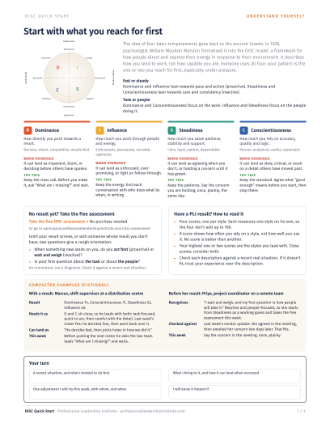
Use the DISC map to spot which style leads, then see how to work with it.

Pick a style to see how to work with it. Everyone shows all four; one or two usually lead.
First page of the DISC Quick Start guide

Use DISC in your next conversation.

The DISC map, how to work with every style, and a 25-minute pair or team conversation.

Three pages, with worksheets you can fill in · free to download and share.

From your report

Working with every style.

You’ll rarely know someone’s exact type. Spotting which style leads is usually enough to adjust.

DominanceProactive · Task focus

Fast, direct and results-first. Wants a clear position.

Start with
Your view, plainly, and the decision you need
Avoid
Turning a disagreement into a contest
Ask
“What do you need from me?”
InfluenceProactive · People focus

Warm and energetic, and talks ideas through out loud. Needs the relationship to feel right.

Start with
A minute of genuine connection before business
Avoid
Cutting off their thinking out loud
Ask
“Who else needs to be on board for this to work?”
SteadinessReactive · People focus

Steady, loyal and careful with change. Rarely says no out loud.

Start with
Explain the reason for a change, not just the change
Avoid
Reading silence as agreement
Ask
“What would make this easier for you to do well?”
ConscientiousnessReactive · Task focus

Precise and reserved, and wants the reasoning settled before moving.

Start with
Bring the facts and give them time to check
Avoid
Rushing them to a decision
Ask
“What would you need to see to be confident?”

Justin Mitchell

Founder, Professional Leadership Institute

The people behind PLI

Practical learning for work.

Justin Mitchell used DISC and practical training in his own businesses before bringing that learning to PLI. His focus is helping people and organizations grow, strengthen their leadership and pursue excellence in what they do.

Founded in 2017, Professional Leadership Institute has helped more than 180,000 people. Its assessments, courses and team tools help people and organizations grow through stronger leadership, communication and practical learning.

How your report comes together

How the PLI DISC assessment works.

50 questions explore how you approach work, decisions, pressure and other people. Your report brings those answers together into tendencies you can reflect on and put to use.

Four ways to reflect on how you work.

  • 16 agreement statements
  • 14 ranking questions
  • 12 two-option choices
  • 8 select-all questions

These formats ask how strongly a statement fits, what you prioritize, which alternative you prefer and what applies in a work situation.

Turn insight into a useful next step.

Use your report to recognize strengths, explore communication habits and choose something to try at work. Discuss what fits with someone who knows you, and revisit it as your experience grows. DISC describes behavioral tendencies; your result is a starting point, not a fixed label.

Before you begin

DISC assessment
questions and answers.

Understand the Free offer, self-service team setup and the right way to use the result.

Ask PLI a question

Is the DISC assessment really free?

Yes. The assessment and Free report require no purchase. Premium is optional at … USD once for your personal report. Group report terms are separate.

After the questions, we ask for your name, email, phone and the reason you’re taking it, so we can send your report.

How many questions are there, and how long does it take?

There are 50 questions: 16 agreement statements, 14 ranking questions, 12 two-option choices and 8 select-all questions. Your answers are saved as you go on this device, so you can come back and continue.

We have not established a reliable measured completion-time estimate for this version. The questions explore work style, pressure, working with others and decisions. Read how the formats work.

What does DISC stand for? Is there a best style?

DISC stands for Dominance, Influence, Steadiness and Conscientiousness. These describe broad behavioral tendencies. Everyone can show all four; no style is best. The grid places D and I in “move first,” C and S in “weigh first,” D and C in “task first,” and I and S in “people first.”

Publishers use their own blend labels and profile names. PLI’s Driver, Spark, Anchor and Analyst samples are examples of its naming system, not extra DISC dimensions. A lower score does not mean lower ability.

If a description does not fit, note a counterexample and the situation in which it does or does not apply. Ask someone who works closely with you for their perspective; do not force yourself into a label. Your context and experience matter.

Read the short DISC definition and explore the sample reports.

How should I read my four scores and use the report?

Read the four scores as separate dimensions. They do not need to add to 100. A higher score describes more emphasis in your answers, not more ability or a better result. When scores are close, consider both tendencies instead of treating a small difference as a fixed identity.

Check a description against a recent situation. Choose one useful insight, ask a colleague whether it fits, and try a small adjustment. The Free examples include an observation worksheet; Premium adds scripts and a separate development plan. These are suggestions to test, not promised outcomes.

Band words and profile labels depend on the scoring rules. Some draft sample bands differ between Free and Premium despite matching scores. Read the score explanation and its limits, and check the draft-sample notes.

How do I upgrade to Premium?

Premium is an optional personal upgrade at … USD once, before applicable taxes. You keep your Free report and add a separate report with more work situations, conversation scripts and development tools, using the same answers.

You do not need to retake the assessment. Your result page and Free report email include the upgrade option.

How accurate is DISC, and what should I use it for?

The evidence available here does not yet establish reliability or validity for this PLI assessment version in real respondents. Internal simulations check constructed response patterns; they do not establish real-world accuracy.

Use your report for reflection and conversation, and check its suggestions against experience and feedback. A self-report does not establish how others experience you, and a description may not fit every situation. Read the method, evidence and limitations.

How should I choose a DISC assessment for my team?

Start with the work you want to improve: clearer feedback, smoother onboarding, a more useful team conversation or better communication across different preferences. Read a complete report and decide whether its examples, language and proposed actions are useful for that purpose. Check the method and evidence for the particular assessment.

Compare what is free, what costs extra, how invitations work, the available support and who can access individual results. A personal report alone does not diagnose team dynamics. Compare providers and product routes.

Inspect the participant’s report experience, then explore the free Workspace and PLI ecosystem. When you are ready to organize a group, set up your free Workspace. Coaches and trainers can also explore the Partner offer.

Can DISC help with hiring and onboarding?

Use DISC after hiring to discuss working preferences, feedback and support during onboarding. A job candidate can also use their own report for reflection.

Do not use it to screen, rank or select candidates, predict performance or establish job fit. It does not measure aptitude. Make participation and result-sharing arrangements clear.

Who created this assessment? Is it Wiley’s Everything DiSC?

PLI publishes its own assessment. Justin Mitchell, PLI’s founder, is an Everything DiSC® Certified Practitioner through Wiley. That credential does not mean Wiley created, endorsed or validated PLI’s instrument.

Usage totals and review ratings are not evidence of psychometric validity. Evidence for another publisher’s assessment does not validate this one. Read what has and has not been established for PLI’s assessment.

Can I set up Workspace myself? Is it free?

Yes. Create your own free Workspace account (opens in a new tab). Workspace is the dashboard for team and client use; you do not need a sales conversation to create an account. The documented account flow is to verify your email, then be signed in automatically with your first group created. You can organize groups and invite participants with a link or QR code.

Account access is free. Paid group reports are a separate offer, with branding available on paid group reports. The … personal upgrade is not a group license. Confirm report choices, group pricing and applicable result access before inviting people.

The link opens account registration. Explore team rollout and coach support if you need help choosing a route.

If my organization invites me, who can see my result?

When you take the assessment through an organization’s group link, that organization, including the people it has invited to manage the group, receives your result and report. Taken here, without a group link, your result is yours. Before a group assessment, ask the inviting organization how they will use and share results.

Ask PLI about your group’s access arrangements.

How will I receive my report? What if I cannot find it?

You see your result online as soon as you finish, and your report arrives by email. Check the inbox and spam folder for the email address you used.

If you still cannot find it, contact PLI for help with your report. Do not post assessment answers or personal results publicly.

What is included in the Quick Start guide?

The Quick Start has three pages: the DISC map and the four styles, how to work with every style (with a worked message), and a 25-minute conversation for a pair or team. Its prompts help you choose one change, an owner, a date and a check.

Download the three-page Quick Start (PDF). Use the examples as conversation aids and ask about a person’s preferences rather than assuming a style fits.

What am I looking at in the Free and Premium samples?

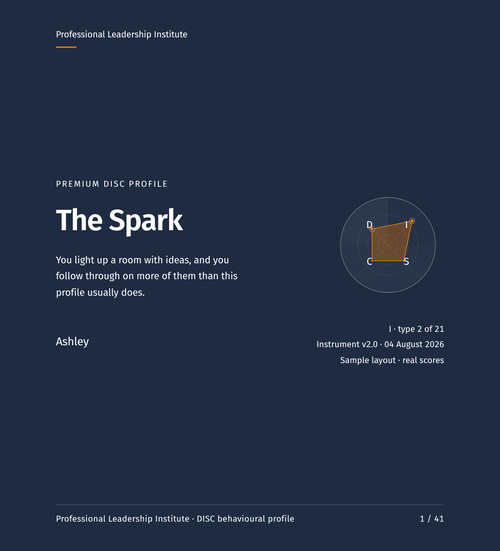
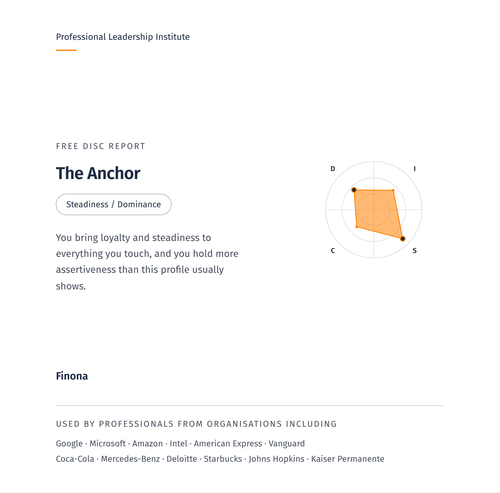
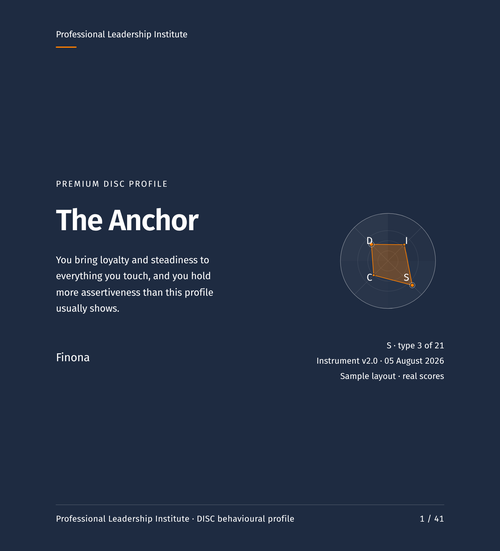
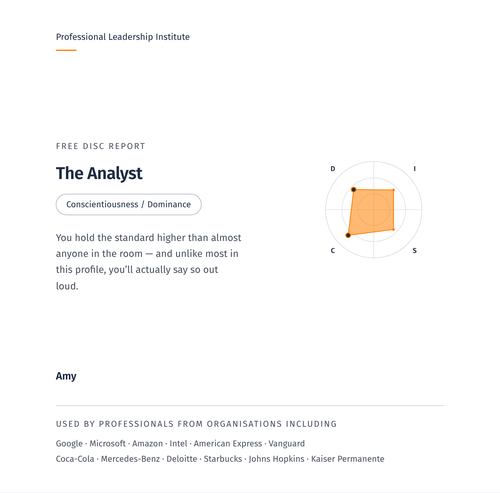
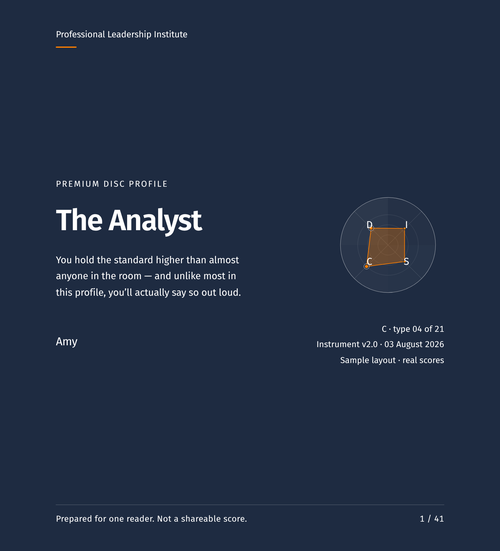
You can inspect four genuine sample pairs: D / The Driver, I / The Spark, S / The Anchor and C / The Analyst. Each pair uses the same named example and numeric scores in Free and Premium. These examples still include all four dimensions; they are not pure 100/0 profiles and are not results from your assessment answers.

Each Free sample has 17 pages and each Premium sample has 41, including covers and part dividers. The readers include every source page, matching-style tier navigation and downloads of the complete original HTML drafts. Those report downloads are HTML files, not PDFs; the Quick Start PDF is a separate guide.

The samples demonstrate the report content, including practical suggestions. They are not certified current production outputs and retain provisional scoring, privacy, product and editorial wording. The draft notes inside each reader identify unresolved source claims. Choose a sample pair.

Start with your own insight.

Your assessment and Free report require no purchase. Choose one insight to put into practice.

Start your free assessment