

What is reciprocation
Reciprocation is the innate human behaviour to respond positively when one receives a gift. This desire to reciprocate comes out of a feeling of owing someone something. This feeling occurs regardless if you asked for the gift or not.
Famous psychologist Robert Cialdini has studied the application of reciprocation in persuasion and business. In his book, Influence, The Psychology of Persuasion, he debunks the idea that decision making is driven by information and outlines the six principles (short cuts) that actually influence outcomes – reciprocity is one of them.
When used appropriately, reciprocation can help an individual and organization amass the type of network that generates real value. Reciprocation one way to initiate and grow a relationship with a colleague or client. It is also a way to demonstrate individual value and character.
Power of reciprocation in business
In business, the power of reciprocation can be highly beneficial by increasing sales, developing new opportunities, and improving culture.
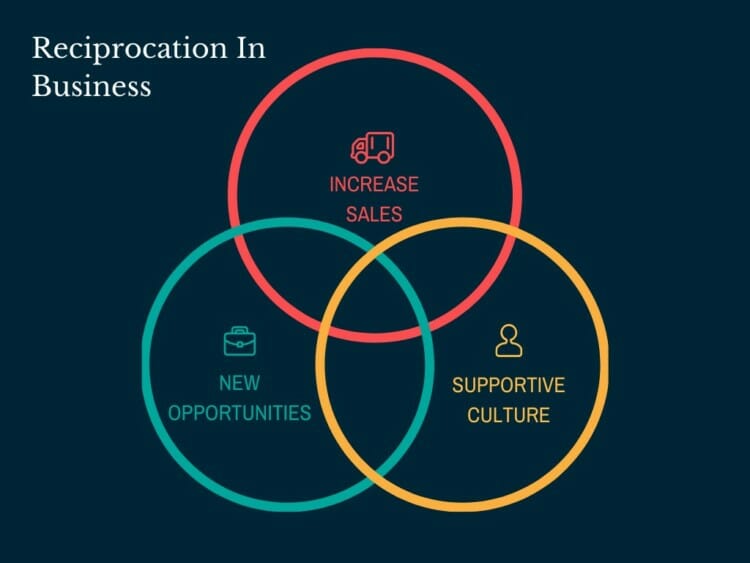
Driving sales – businesses have reported that providing potential customers with a gift can get them to reciprocate as a customer. Storage company Dropbox paired the power of gifting with network effect or referrals to grow their userbase from 100,000 users to 4 million in 15 months. Additionally, such freemium models have proven to convert users to paid customers, all through the power of reciprocation. Companies such as Spotify have attributed their success by being able to use a freemium model to convert users into paid customers.
Developing opportunities – business partnerships that support companies in achieving their objectives are built on the pillars of reciprocation. They do this by having provided access to resources and capabilities that the other business would otherwise not have. This allows each partner to add value to the other’s business while helping each other reach their goals.
Improving culture – employees who are givers create a virtuous cycle of reciprocity. By having givers always helping and couriering favours, recipient employees will feel the need to reciprocate. As a result, the organization creates a culture of support and collaboration, which is attractive to customers and potential employees. This can lead to higher job satisfaction as well as higher overall company performance.
How to tell when a relationship is not reciprocating
It is important to understand that not all employees respond to generous gestures with reciprocation. These individuals are known as takers and can actually be leeches in an organization. While employees who do not reciprocate do not pose an immediate threat, over time they detract value to an organization. Below are telltale signs of a one-sided relationship.
- Lack of appreciation – business partners, colleagues, or clients that do not demonstrate appreciation for favour or gift are signalling that they do not value the gesture. As a result, they may not reciprocate in the future or when asked for a favour. Such a signal can also deter someone from being a giver in the future.
- Excuses for lack of action – those who are takers will find many excuses as to why they cannot reciprocate. These should be early warning signs that the relationship is headed in a lop-sided direction. Reciprocation does not need to be grandiose – even a simple coffee is well within everyone’s means to do.
- Lack of ownership – for the strongest of relationships, mutual reciprocation requires that both parties actively take ownership in reciprocating gifts. This is how momentum in a relationship builds, growing it into one that has trust and adds value to both parties involved.
Ways to garner reciprocation
There are different ways that individuals can gift to colleagues and client to elicit a sense of reciprocation. These include:
- Gift – giving a gift to the most literal way to garner reciprocation. Sending a gift to a client or colleague can elicit positive feels and association to the gifter. This has proven to nudge important people to return your calls.
- Favors – in some cases, performing a favor for a colleague or client may generate a stronger sense of reciprocation than a gift. Asking for help takes a certain level of vulnerability; being gracious when helping someone with a favor can drive a sense of indebtedness. It also helps to build trust between two individuals.
- Ingratiation – compliments and positive affirmations, when done authentically, can also generate a positive association with an individual, which can generate reciprocation. For example, if you compliment someone by telling them they’re nice, there is a chance they will feel the same way about you in return.
- Share – while they are not exactly a gift, sharing interesting articles or invites to events can lead people to feel in some ways indebted. Not only does this build common interest and talking points, the recipient will feel inclined to share their interesting readings with you in return. This can be a key tool in building a relationship with a colleague or client.
Key takeaways
- Reciprocation can be highly beneficial in business by driving sales, developing partnerships for opportunities, and creating a collaborative culture
- Reciprocation does not always have to be large gifts; simple gestures like compliments and sharing of articles are great ways to build in building a valuable relationship
- Beware of one-sided relationships – signs such as persistent excuses, lack of appreciation, and lack of ownership are usually the first symptoms of an individual who will not reciprocate