

Over the course of history, external factors have forced inevitable change upon organizations. In the face of this, some organizations thrive. These businesses reinvent themselves and become trailblazers in their industries. Others falter and struggle to restart, leading them to their demise.
For example, Blockbuster dominated as the video rental company in the 90’s. However, their miss-steps led them to their eventual bankruptcy in 2010. The company never viewed Netflix as a viable competitor. Additionally, they never viewed digital streaming as a real threat.
In comparison, between its inception in 1997 to present day, Netflix evolved its business three times to change with the times – first as a DVD rental company, then as a subscription-based DVD rental company, and finally as the Netflix we know of today. Their ability to embrace the inevitable change of consumer preferences and technology led to their meteoric rise. Today, Netflix is a $215 billion dollar company while Blockbuster ceases to exist.
The Blockbuster story is just one of many examples of how businesses need to organize themselves for change.
Transforming an organization for inevitable change
The signals and signs of change are not always obvious. In the case of Black Swan events, there is no amount of preparing that can galvanize an organization against the event’s long-term impact. Take the COVID-19 pandemic as an example. No one could have seen a global pandemic over the horizon. As a result, businesses are having to adapt at warp speed. And some companies are being left behind.
Such events are a sobering reminder that it is not enough for organizations to plan for change. Instead, organizations need to adopt a culture which espouses adaptability and flexibility. By adopting this mindset, teams will ready with the knowledge and capabilities for turning tough situations into opportunities. With that, there are four ways that leaders can prepare their organization for inevitable change.
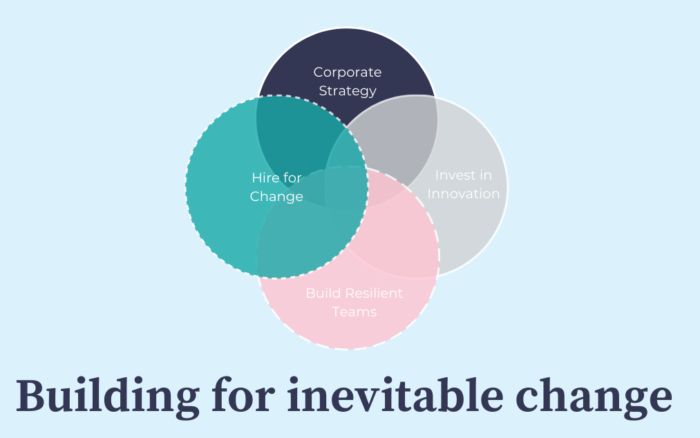
Hire for inevitable change
It is important to understand whether the organization has the types of leaders who embrace and welcome change. It is also imperative to understand whether these leaders are in the right place. Are there key individuals who are resistant to change and if so, what are their reservations and trepidations?
Leaders who are not onboard to do what is necessary to help an organization evolve will become blockers in the organization succeeding. There may be personal motivations for not welcoming change. Alternatively, they may simply fear change. Either way, such attitudes may manifest itself as toxic behavior. Examples of such behavior include negative engagement in meetings or even unwillingness to complete work tasks.
As a result, it is important to understand where your leaders stand on their propensity to change. Even more important, organizations should check in regularly with their leaders to see if their motivations still align with the company.
Build resilient teams
After identifying the right leaders, the next step is to facilitate a culture that fosters resilient teams. Teams that can manage and work through uncertainty can translate these skills to effectively deal with change.
One way for teams build resilience is to practice responding to crisis. By going through such an exercise, the team members will form their own norms around how they want to work with one another. Additionally, they will receive practice on how to respond In an environment that is changing quickly and with minimal to no information is available. This enables the team’s ability to work together through difficult scenarios as well as develop norms on how to handle uncertain situations.
Adopt a strategy that rewards flexibility
Flexibility can read as high costs to organizations that pursue cost leadership as their corporate strategy. However, it is important to recognize that companies need flexibility in order to adequately respond changing environments. Additionally, organizations can build flexibility into their overall structure without sacrificing cost.
For example, Toyota’s structure focuses on continuous innovation. Their structured in a way which enables them to incorporate employee suggestions to iterate their manufacturing processes. These suggestions allow the company to drive down production costs. The incorporation of these improvements into their manufacturing would not have been possible if the organization culture was not flexible.
By shaping the organization’s rewards, incentives, and controls in alignment with managing and even encouraging change, organizations can shift employees focus to becoming more adaptable to situations, even before being adaptable is required.
Invest in innovation
Pursuing innovation may seem like another management fad, however the companies which have come out as leaders have done so with the help of innovation. Netflix’s simple innovation upon their revenue model and then again with their primary product helped them beat out Blockbuster.
Another company that prides itself on innovation is 3M. Their ability to commercialize their innovations has allowed them to survive over a century, transforming from a mining company to the multi-national conglomerate that it is today.
Key takeaways
- External factors will lead to inevitable change for an organization; how an organization responds to these external factors will dictate whether they thrive or falter.
- Organizations need to ensure that they have the leaders that are willing to lead change as well as prepare teams for resilience.
- Leaders need to facilitate an environment that is responsive to change by creating a corporate strategy that rewards the behaviors of flexibility.
Related Readings
Professional Leadership Institute (PLI) is an educational website providing professionals from all types of businesses with practical education in human resources and leadership. To keep evolving your leadership toolkit, additional PLI resources below will be useful: