
Most companies have both managers and supervisors that provide guidance to employees. Sometimes these titles are even used interchangeably, and the differences can be overlooked. However, although they are both leadership roles, there are distinctions between the two that you should know. In this article, you’ll learn about these distinctions including the definition, responsibilities, and types of managers versus supervisors.
Key takeaways
- Managers and supervisors both play critical roles in an organization
- Although they are both leadership positions, there are some key differences between managers and supervisors
- Responsibilities of a manager include setting objectives, managing budgets, coordinating with human resources, coordinating with executive management, overseeing operations, and creating a healthy work environment
- Responsibilities of a supervisor include managing a team’s workflow, managing new hires, conducting performance evaluations, liaising with management, problem-solving
- Traits of effective managers are effective communication, ability to delegate, being caring, empowering, and results-oriented
- Traits of effective supervisors are effective communication, empathy, conflict resolution, leadership, and time management
- The key areas where managers and supervisors differ are their focus, objectives, compensation, authority, and responsibilities
What does a manager do?
Managers are considered middle management positions. A manager plays a strategic leadership role in a specific department or division of a company. They are the ones who oversee an area of a company and act as the decision maker for a team. Managers focus on overall direction, goals, and the effectiveness of workflows conducted by team members.
What are the responsibilities of a manager?
A manager has a number of key responsibilities including:
Setting goals and objectives
Managers are responsible for the big picture strategy. That’s why managing and tracking goals and objectives using key performance indicators (KPIs) are a part of their role. They take the organization’s mission and figure out how team members can help achieve it by setting goals.
Managing budgets
Organizations often have a finance department, but it is up to the manager to track their team spending based on budgetary responsibilities set by the department. They are often involved in creating budgets, clearing reimbursements, and approving expenses.
Coordinating with human resources
Managers are responsible for Identifying gaps in staffing and working with human resources to mitigate. Depending on the structure of the organization, they may identify the gap and outsource to human resources, they may tell them what the job responsibilities and qualifications are, they may interview and hire somebody themselves, or any combination of these activities.
Coordinating with executive management
Managers act as the middleman between the executive team and their own team. They provide the necessary communication from the top-down and bottom-up, whether that be telling employees about a new strategic objective or reporting on key projects to executive management.
Overseeing operations
Although managers are less hands-on in the operations of a team, they are responsible for ensuring that things go smoothly. They are the ones who enforce the standards set by the organization when it comes to the quality of work completed.
Creating a healthy work environment
Managers are tasked with ensuring that employees have a safe, healthy, and positive work environment to be in. This means setting certain guidelines, ensuring employees are following regulations and laws, and mitigating any safety concerns promptly.
What personality type best suits the role of a manager?
The ideal personality of a manager is someone that is determined, driven, and decisive. Managers are decision-makers, and this includes making difficult decisions such as letting people go or saying no to projects. Managers need to be objective in these types of situations. They also need to be able to look beyond their own team at the bigger picture strategies of the organization. By being able to zoom out like that, they are able to ensure alignment with organizational goals.
Take our free DISC personality test today!
What are some important character traits of managers?
Moreover, there are a number of key character traits that make an effective manager. These include having effective communication, the ability to delegate, being caring, empowering, and results-oriented.
Effective communication
Communication is important at all levels, but especially in leadership positions like a manager. Managers need to communicate with supervisors, executives, and team members, so it’s important to do so effectively.
Ability to delegate
Managers typically are less hands-on with the day-to-day operations of teams. That’s why it is important that they are able to effectively delegate responsibilities to others in order to follow strategic objectives. They need to be able to delegate to team members and supervisors based on strengths and capabilities.
Caring and Empowering
Great managers care about their team or division. Being caring helps foster positive relationships and reduces friction between different hierarchies of employees. Further, managers are successful when their teams are successful. They need to be able to motivate and empower employees in order for goals to be met.
Result-oriented
Managers have goals from upper-level executives that they are expected to work towards. Thus, being results-oriented is important. Managers need to be able to measure the success of their teams and ensure they are on the right path when it comes to the big picture strategy.
What is the salary of a manager?
The salary of a manager depends largely on their official title, seniority, the field they work in, the company they are a part of, and other factors. That being said, according to Glassdoor, the average base pay for a manager in Toronto, Ontario is $83,298 CAD annually.
Here are some examples of managers in different fields, and what the average annual salaries are in Canada:
- Marketing manager: $72,453 CAD
- Accounting manager: $84,448 CAD
- Sales manager: $81,123 CAD
- Operations manager: $68,192 CAD
- Finance manager: $89,619 CAD
- Human resources manager: $74,631 CAD
What does a supervisor do?
Supervisors are considered first or lower-level management positions. A supervisor plays a leadership role, but in a different capacity than managers. Typically, a supervisor is a leader who is directly responsible for employees, while working under a manager. They work with team members on the day-to-day responsibilities that help achieve overarching goals set by managers. They also serve as the direct point person for team members to contact if they have questions or concerns.
What are the responsibilities of a supervisor?
A supervisor has various responsibilities based on their workplace and team environment. Some key tasks that supervisors carry out include the following:
Managing a team’s workflow
Supervisors are primarily responsible for ensuring a team meets its deadlines, goals, and objectives. There are many tools they may use for doing so including schedules, digital planning tools, and goal trackers.
Managing new hires
New employees require orientation and training in order to feel comfortable and welcome on the job. Supervisors typically are responsible for the training of these new hires, explaining their role, introducing them to different team members, and getting them settled into the workplace.
Performance evaluation
Supervisors are more hands-on in the day-to-day activities of employees, so they are the best people to give feedback on their performance. They provide regular feedback to team members, so they know how they’re performing and whether there are areas for improvement. This evaluation can be formal or casual depending on the supervisor.
Sponsoring employees
Supervisors often act as sponsors for employees to higher management. When an employee excels or expresses interest, supervisors are expected to support their career development, whether it be by recommending them for a promotion or supporting them in getting a raise.
Liaising with senior management
Supervisors work closely with the team they’re in charge of, much closer than managers do. Because of this, they are the liaison between regular employees and management. They effectively communicate what’s necessary between the two levels of employees.
Problem-solving
Supervisors are typically the first line of contact when an employee is experiencing any conflicts. Problem solving can occur in several ways, including but not limited to helping the employee work through the conflict, disciplinary action, and escalating to a manager if necessary.
What personality type best suits the role of a supervisor?
Supervisors need to be able to take charge and ensure things are done correctly. A good supervisor is someone who is also able to balance the needs of the team and the needs of management. This requires someone to be both people and results oriented, especially when it comes to things like giving both positive feedback and constructive criticism to employees.
What are some important character traits of supervisors?
Additionally, there are several key qualities that make a successful supervisor. These include effective communication, empathy, conflict resolution, leadership, and time management.
Effective communication
As a supervisor, you are communicating all the time. Employees come to you when they have issues and managers come to you to ask how the team is doing. That’s why effective communication, especially when it comes to interpersonal communication, is critical to the role.
Empathy
Supervisors deal with employees. And these employees will have their ups and downs, going through struggles as we all do. Being empathetic and compassionate with team members helps supervisors understand employees and provide better guidance in problem-solving.
Conflict resolution
Supervisors need to resolve conflicts within the team in order to strengthen relationships and promote effective workflows. If a supervisor is able to handle conflicts, it also shows managers that they are competent and capable of keeping the team afloat.
Leadership
Just like managers, supervisors are leaders. Supervisors need to take initiative when it comes to delegating tasks and keeping team members on track to meet set goals. They need to understand the strengths of their team members and act accordingly to make for an effective work environment.
Time management
Team members typically have a lot of tasks to complete on a daily basis. Supervisors are responsible for making sure these tasks are prioritized and managed in a way that is productive and doesn’t leave employees feeling overwhelmed.
What is the salary of a supervisor?
Just like managers, the salary of supervisors varies based on a number of factors. Overall, Glassdoor reports that a supervisor in Toronto, Ontario makes an average base pay of $54,454 CAD per year.
Here are some examples of supervisors in different fields, and what the average annual salaries are in Canada:
- Marketing supervisor: $59,793 CAD
- Accounting supervisor: $69,534 CAD
- Sales supervisor: $54,720 CAD
- Operations supervisor: $62,031 CAD
- Human resources supervisor: $69,955 CAD
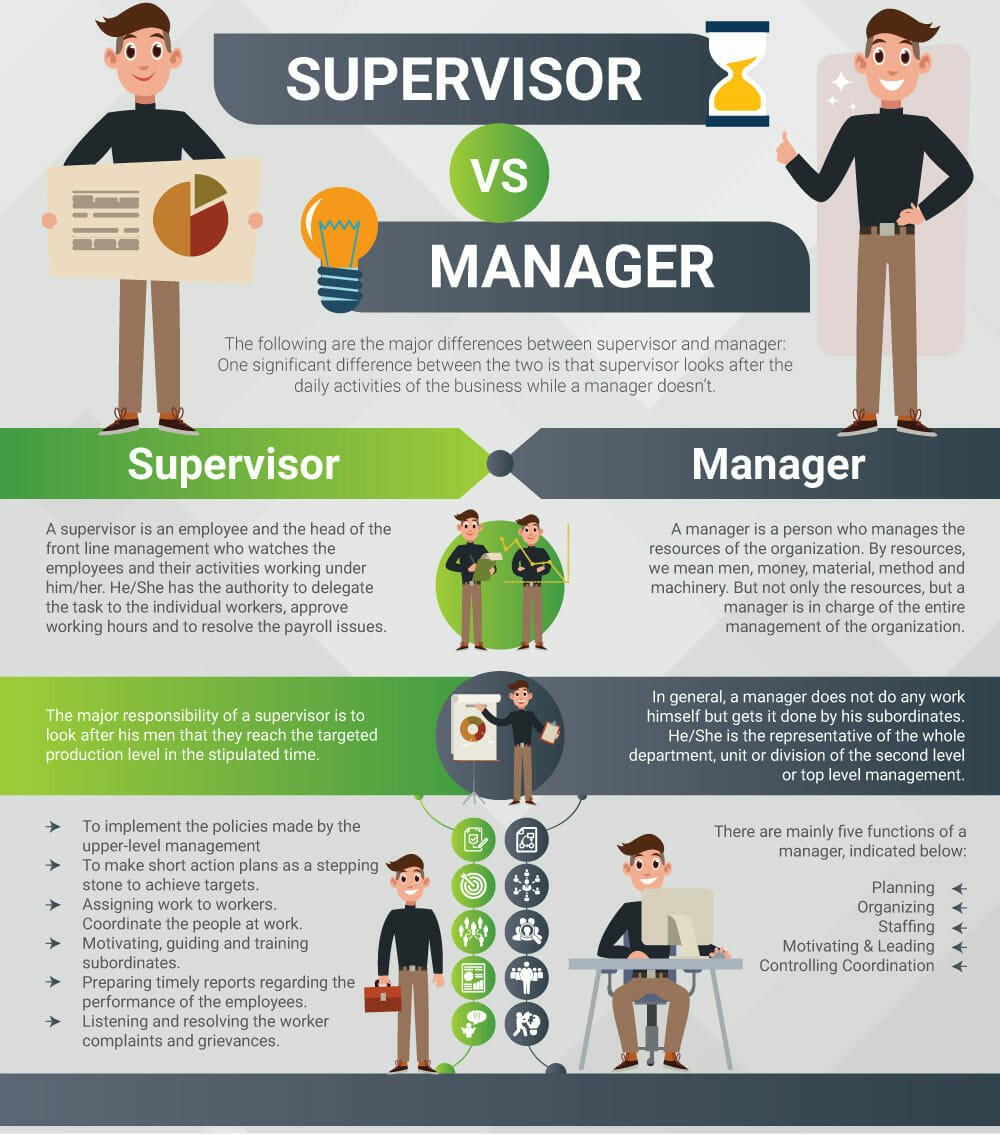
What are the differences between a manager and a supervisor?
The primary distinctions between a manager and a supervisor are differences in focus, objectives, compensation, authority, and responsibilities.
Focus
While a manager focuses externally (of the team) on the overall strategic initiatives and the overall organization, a supervisor focuses internally on their team when it comes to their responsibilities.
Objectives
Managers and supervisors have different objectives based on their focuses. For example, an objective for a manager could be to discuss strategic goals for the upcoming year with executives. On the other side, a supervisor’s objective might be to communicate to team members about daily quotas that align with these strategic goals.
Compensation
A manager ranks above a supervisor in terms of organizational hierarchy, and as a result, compensation differs. Managers typically earn more than supervisors do as they are more senior-level management.
Authority
Another difference between managers and supervisors is the level of authority each has. In general, managers oversee supervisors, who oversee teams. Thus, managers have more authority than a supervisor and are often communicating from executive level management to the team’s supervisor.
Responsibilities
As discussed previously, managers and supervisors have differing responsibilities. While managers play strategic roles, supervisors are more heavily involved in the daily workflows and operations of the team.
Related Readings
Getting People Right (GPR) is an educational website providing professionals from all types of businesses with practical education in human resources and leadership. To keep evolving your leadership toolkit, additional GPR resources below will be useful: