A DISC test helps you understand how you tend to communicate, make decisions, respond to pressure and work with other people. PLI’s free online DISC test takes about 10–15 minutes, asks 25 ranking questions and gives you a result across four behavioral dimensions. You can see your free result before deciding whether to purchase a deeper report.
More than 250,000 people in over 130 countries have registered for PLI’s DISC assessment, and PLI ranks #1 on Google for “DISC reports” (Ahrefs, September 2026).
Take PLI’s free online DISC test: 25 questions,10-15 minutes
What Is a DISC Test
A DISC test is a self-report behavioral assessment. It describes patterns in how you approach tasks, people, decisions and change. The name comes from four dimensions: Dominance, Influence, Steadiness and Conscientiousness. PLI uses the style names Dominant, Inspiring, Supportive and Conscientious.
Everyone has a combination of all four. A result gives you useful language for discussing how you prefer to work, but it does not measure intelligence, integrity, technical ability or future job performance. There is no pass or fail. For the wider model and its history, see What Is DISC?
What Does the DISC Test Measure?
| PLI style | What the dimension explores | A question it helps you ask |
|---|---|---|
| Dominant (D) | Directness, pace and focus on outcomes | Do I move toward a decision quickly? |
| Inspiring (I) | Expressiveness, enthusiasm and social connection | Do I think aloud and engage people through ideas? |
| Supportive (S) | Patience, cooperation and consistency | Do I prefer predictability and time to support others? |
| Conscientious (C) | Accuracy, analysis and attention to standards | Do I want evidence and clear quality criteria? |
These are broad tendencies, not fixed descriptions of every person. For a deeper explanation of each style, use PLI’s dedicated DISC style and profile resources rather than treating this introduction as a complete interpretation guide.
How Does PLI’s Online DISC Test Work?
You rank groups of four words from most like you to least like you. After 25 questions, the assessment calculates your pattern across the four DISC dimensions, and you enter your details to receive your free result. There is no correct order. Answer based on what is most typical of you, not what sounds most desirable
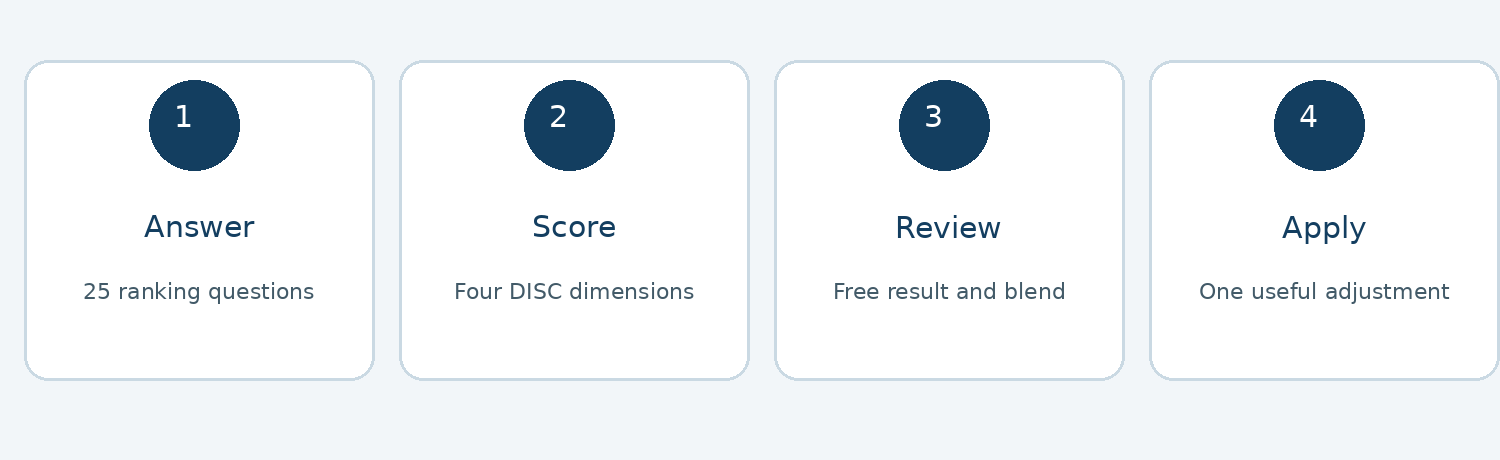
Figure 1. The four stages of taking and using PLI’s online DISC test.
DISC Test Questions: What Should You Expect?
A DISC test asks about behavioral preferences, usually through descriptive words or statements. PLI’s assessment uses ranked word groups rather than a knowledge quiz. You will not be asked to solve math problems or demonstrate job-specific expertise.
| What you do | Why it matters |
|---|---|
| Rank all four descriptions | Your relative preferences contribute to the profile. |
| Answer as you normally behave | Idealized answers may make the result less useful. |
| Finish all 25 questions | The scoring needs your completed response pattern. |
| Review the free result | Look for a tendency you recognize and one adjustment to try. |
Different DISC publishers use different questionnaires and scoring methods. PLI’s 25-question experience should not be assumed to describe every DISC test online.
Is the DISC Test Free?
Yes. PLI’s individual DISC test and its initial results are free. You can complete the assessment online and view your scores without purchasing a report. If you want more personalized interpretation, PLI offers an optional Premium DISC report for $17 USD. The Premium report builds on the assessment you already completed, so you do not need to retake the test.
Start the free DISC test and view your result
How Accurate Is the DISC Test?
98% of people say their PLI report describes them accurately, and 87% of colleagues agree with the person’s profile. These figures show how well people feel the report fits them. PLI is also formalizing a psychometric study comparing its assessment with the three leading DISC assessments in Google’s rankings.
What a DISC test should not be used for is predicting performance. A 2024 meta-analysis of 45 studies and 3,331 teams found generally weak relationships between team members’ personality traits and team performance (Han and colleagues, Journal of Research in Personality). DISC is most useful as a starting point for conversation and practice, not as a forecast.
A practical way to judge your own result is to ask: Which descriptions match how I actually behave? When do these tendencies help? Where might I need to adapt?
What Can You Use a DISC Test For?
1. Communicate with more clarity
Suppose a colleague asks for a detailed explanation when you are trying to move a project forward. DISC gives you a way to ask what information is essential before deciding, rather than assuming the colleague is obstructive.
2. Make feedback more useful
A manager can ask whether an employee prefers feedback in a direct summary, a discussion or a written follow-up. The employee’s answer matters more than any assumption based on their profile.
3. Support teamwork
Teams can compare communication preferences and agree how to raise concerns, share updates and clarify decisions. PLI offers team reporting and training for organizations that want to use DISC beyond an individual result.
4. Build self-awareness
A test result is most valuable when it leads to a practical change: asking one more question before deciding, giving a clearer deadline or making space for a quieter colleague to contribute.
DISC should not be used on its own to select employees, determine promotions, diagnose conditions or predict success. Workplace decisions require job-related evidence and appropriate professional judgment.
What Happens After You Take the Free DISC Test?
Your free result shows your DISC pattern and a starting interpretation. If you want a more detailed personal report, PLI’s $17 Premium option provides expanded guidance, places you in one of PLI’s 21 named DISC types, and adds “With you” notes on how you tend to work with each of the others
To read your profile in more depth, see PLI’s guide to your DISC profile.
For organizations, PLI also offers a team portal and separate team reports. If your goal is to compare colleagues’ profiles or plan team training, use the organizational path rather than assuming an individual free result includes all team features.
Explore DISC for teams and organizations
Frequently Asked Questions About the DISC Test
What is a DISC test in simple terms?
It is a behavioral questionnaire that describes your preferences across four DISC dimensions. It helps you reflect on how you work, collaborate, and communicate.
Can I take a DISC test online for free?
Yes. PLI offers a free online DISC test with 25 ranking questions and a free initial result. An optional Premium report costs $17 USD.
Are DISC test questions difficult?
No. They aren’t knowledge questions. You rank words by how well they describe your typical behavior, and there are no right or wrong answers.
Can I retake the DISC test?
Your preferences tend to be fairly consistent, but behavior changes with role and context. If your situation has changed significantly, taking the test again can be a useful point of comparison.
Is DISC the same as a personality or aptitude test?
DISC is commonly called a personality test, but it focuses on behavioral preferences. It is not an aptitude, intelligence or clinical assessment.
Take Your Free DISC Test With PLI
Start with 25 questions and your free result. See how your four DISC dimensions combine, choose one communication adjustment you can test this week, and decide whether the optional $17 Premium report would add value for you.
Take the free DISC assessment now